
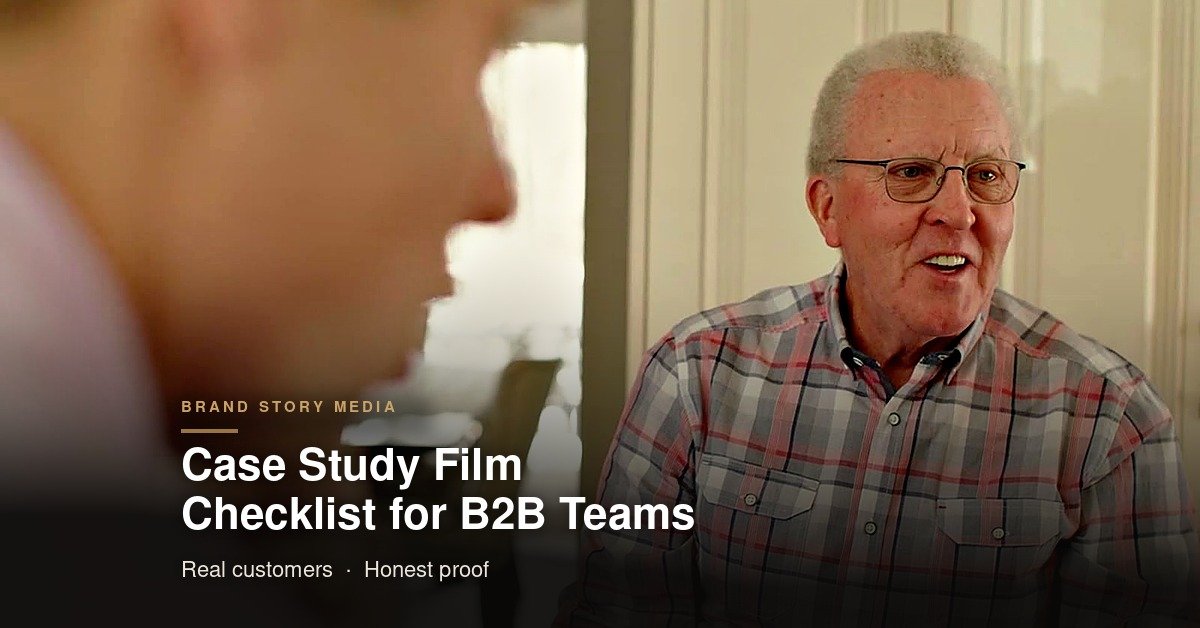
A case study film is simple to describe and easy to get wrong. At its best, it’s a real customer explaining, in their own words, a problem they had and how working with you changed it. At its worst, it’s a client reading praise off a script while a logo spins in the corner. Buyers can tell the difference in seconds.
We direct customer story films for B2B teams in Toronto and across the GTA, and most of the work that makes them land happens before anyone presses record. This is the checklist we use, from a director’s chair. It covers who to interview, what proof to show, and how to keep the story honest on camera. It’s the same thinking behind our case study films.
If you’re still deciding which format you need, our post on testimonial videos vs case study videos explains the difference.
Before the shoot: pick the right story
1. Choose a customer with a clear before and after
The strongest case studies aren’t always your biggest accounts. They’re the ones with a story you can see: a process that was slow and became faster, a team that was stretched and found room, a launch that was stuck and got moving. Look for a change the customer can describe without reaching for jargon.
2. Confirm the customer actually wants to do it
An enthusiastic customer gives you a better film than an important one who agreed out of politeness. Ask early, explain what the day involves, and give them an easy way to say no. Get written approval from their side, including their communications or legal team if they have one, before you book a crew.
3. Agree on what can and can’t be shared
B2B customers often have limits: no pricing, no names of their own clients, no screens with internal data. Write these down before the shoot so nobody is surprised in the edit. It’s much easier to plan around a restriction than to cut around it later.
Who to interview
4. The person who felt the problem
This is your main voice. Usually it’s the manager or team lead who lived with the problem day to day, not the executive who signed the contract. They remember the details: the workarounds, the late nights, the moment things changed.
5. One senior voice, briefly
A short line from a director or VP helps a buyer see that the change mattered at the business level. Keep it brief. One or two strong sentences are worth more than a long statement.
6. Someone from your team, if it helps
Sometimes the story needs your account manager or project lead to explain how the work was done. Use them sparingly. The film should feel like the customer’s story, with you in a supporting role.
7. Prepare people without scripting them
We send interviewees a few topics ahead of time, never a script. On the day, we ask open questions and listen for the moment someone stops describing and starts remembering. That’s usually the line that ends up in the film. Our guide to on-camera interview tips covers how to help people relax on camera.
What proof to show
8. The work, filmed where it happens
Proof on film is mostly visual. Film the customer’s team using what you built or delivered, in their real space: the warehouse floor, the office, the site, the clinic. A few minutes of observed work says more than a paragraph of claims.
9. Details that make it real
Close shots of hands, tools, screens and conversations give a case study texture. They also give the editor room to cover cuts in the interview without losing the thread.
10. Numbers only if the customer will stand behind them
A single verified result on a clean title card can be powerful. But it has to be a number the customer has approved and is comfortable seeing in public. If they won’t put their name to it, leave it out. “It gave us our weekends back,” said honestly, often lands better than a percentage.
11. Sales collateral that matches the film
If your sales team will use the film, check that any figures in it match your written case study and deck. Mismatched numbers raise questions a buyer shouldn’t have to ask.
How to keep it honest on camera
12. Let the customer include the hard parts
A story with no friction doesn’t feel true. If the rollout had a rough week, or the first approach didn’t work, let the customer say so. How you handled the bump is often the most convincing part of the film.
13. Don’t put words in their mouth
If a customer’s best line is a little rough around the edges, keep it. Polishing it into marketing language makes it sound like marketing. We edit for clarity and length, not to change meaning.
14. Give the customer a review step
Share a cut with the customer before it goes public, and agree on the review process in advance. It protects the relationship and catches anything sensitive that slipped through.
Making it useful for sales
15. Plan the cutdowns before the shoot
Most B2B teams need more than one length. A two-to-three-minute main film for your website and sales meetings, plus short clips for email, social and proposals. Planning these up front shapes how we shoot. See our post on brand film cutdowns for how one shoot can cover several uses.
16. Decide where the film will live
A case study on a page nobody visits does little. Decide where it goes: the relevant service page, your sales team’s follow-up emails, a proposal template, a trade show screen. Then cut for those places.
The short checklist
- Pick a customer with a clear before and after, who genuinely wants to take part.
- Get written approval and agree on what can’t be shared.
- Interview the person who felt the problem, plus one brief senior voice.
- Prepare interviewees with topics, not scripts.
- Film real work in the customer’s real space.
- Use only numbers the customer has approved.
- Keep the hard parts and the customer’s own words.
- Build in a customer review step.
- Plan cutdowns and placement before shoot day.
FAQ
How long should a case study film be?
For most B2B teams, two to three minutes for the main film works well, with 30-to-60-second cutdowns for email and social. For more on format, see our guide to customer story videos in Toronto.
Can we make a case study if the customer can’t share numbers?
Yes. Many strong case study films use no figures at all. The customer’s own description of what changed, backed by footage of the work, is often more convincing.
How much of the customer’s time does it take?
Usually a short planning call and part of one shoot day at their location. We plan around their schedule so the interview and the observed footage fit in the same visit.
Do you film case studies outside Toronto?
Yes. We’re based in Toronto, work across the GTA, and travel for projects across Canada. Learn more about our case study film service.
Planning a case study film?
If you have a customer story worth telling and want it to feel honest on camera, we’d be glad to help you plan it. Book a call with Brand Story Media and tell us about the customer and the change you made together.