
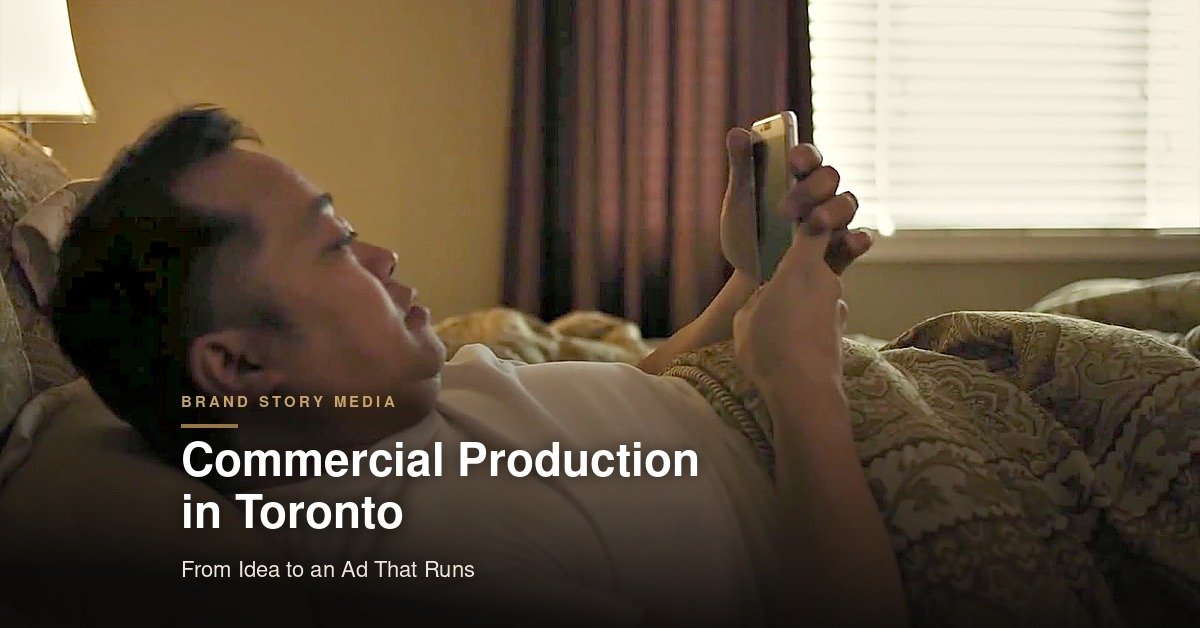
A commercial has a few seconds to earn the next few. In that time it has to stop someone, make them feel something, and leave them with one thing to remember. Most ads that don’t work fail before anyone picks up a camera. They try to say five things, or they’re made for a screen they’ll never play on.
If you’re planning commercial video production in Toronto, this guide walks through how a good spot comes together: finding the one idea, building a story around it, sizing it for where it will actually run, and getting from script to a finished file that’s ready for your website, online placements or broadcast.
What a commercial is (and what it isn’t)
A commercial is built to move someone toward one action. It’s short, deliberate and usually focused on a single message: a product, an offer, a change in how people should see you. Every frame has a job.
That makes it different from a brand story film, which takes its time and earns trust through real people and honest detail. The two work well together. A brand film tells people who you are; a commercial gives them a reason to act now. Many of the best ads borrow the brand film’s honesty and compress it.
Start with one clear idea
Before a script, before a mood board, a commercial needs an idea you can say in one sentence. Not a list of features. One thought.
The one-sentence test
Try finishing this line: “After watching this, I want people to feel ___ and remember ___.” If you need more than one sentence, you have more than one ad. That’s not a problem; it just means you should plan a series rather than squeeze everything into thirty seconds.
Find the story inside the idea
Ideas land harder when they’re carried by a small story. A moment of frustration and the relief that follows. A person, a choice, a change. It doesn’t need dialogue or a big cast. It needs a beginning the viewer recognizes, a turn, and an ending that points to you.
This is where a filmmaker’s instinct matters most. The question isn’t “what do we want to say?” It’s “what would someone actually stop and watch?”
Size it for where it will actually run
The same idea plays differently on a homepage, in a social feed and on a television. Deciding where the ad will run is a creative decision, not a technical afterthought, so make it early.
On your website
A website spot plays to people who are already curious. You can afford a little more breathing room and a slower open. It often sits near a call to action, so the final frame should lead naturally to the next click.
Online and on social
In a feed, nobody owes you their attention. Lead with the most arresting image, not your logo. Assume many people will watch with the sound off, so plan supers and captions as part of the design. Plan vertical and square framings on set, not as a crop in the edit, so the important action isn’t lost at the edges. Shorter versions with different openings let you learn which hook works.
Broadcast and connected TV
Television brings its own rules. In Canada, broadcasters and TV service providers must keep commercials at a similar volume to the programs around them, under CRTC loudness rules, so the final mix has to be built to that standard. Some categories, such as children’s advertising, alcohol, cosmetics, food and health products, may also go through advertising preclearance with Ad Standards before they air. Each broadcaster or platform sets its own delivery specs, so get those in writing before the edit locks.
From idea to an ad that runs: the production path
Every commercial production company in Toronto works a little differently, but a well-run project tends to follow the same arc.
- Brief and idea. A short conversation about the goal, the audience, the offer and where the ad will run. The output is one clear idea everyone agrees on.
- Script and boards. A script, shot list or storyboard you approve before anything is booked. For short spots, a few frames drawn or referenced from photos save a lot of debate later.
- Pre-production. Casting, locations, wardrobe, props, permits where needed, and a shoot schedule. Toronto and the wider GTA offer a huge range of looks within a short drive, which helps, but locations still need to be confirmed and scouted.
- Shoot day. A focused crew capturing the master spot plus the extra angles and framings you’ll need for cutdowns. If social versions are part of the plan, they’re shot here too.
- Post-production. Edit, colour, sound design, mix and music. Music and any stock footage need the right licence for every place the ad will run, including broadcast if it’s on the list.
- Delivery. The master spot, shorter versions, captioned and uncaptioned files, and the formats each platform or broadcaster asked for.
The corporate video production process we walked through earlier follows the same shape. Commercials are tighter at every stage, because there’s less room for anything that doesn’t serve the idea.
What to ask a commercial production company in Toronto
A reel shows you what a studio’s finished work looks like. These questions show you how they’ll get to yours:
- How do you find the idea, and who signs off on it?
- Will you plan versions for the website, social and broadcast from the start, or adapt them afterwards?
- What’s included in delivery: lengths, aspect ratios, captions, broadcast files?
- How is music licensed, and for which uses?
- How many rounds of edits are included, and at what stages?
For a longer checklist, see our guide on how to choose a video production company in Toronto.
How Brand Story Media approaches commercials
We come to commercials as filmmakers. That means looking for the one honest idea first, then building a short story around it that feels made, not assembled. We plan the master spot and the shorter versions together, so one shoot can feed your website, your online placements and your social media content without looking like leftovers.
You can see how we frame this work in our commercials section. Story first, camera second.
Book a call
If you have an idea for an ad, or just a sense that your current one isn’t landing, we’d be glad to talk it through and help you find the version worth making. No pressure and no jargon.
Book a call with Brand Story Media →
Frequently asked questions
How long should a commercial be?
As long as the idea needs and no longer. Common lengths are 15, 30 and 60 seconds, with shorter versions for feeds. Many campaigns use a longer master and cut it down rather than writing each length from scratch.
Do we need separate versions for TV and online?
Usually, yes. The idea can stay the same, but online versions often need a faster open, captions and vertical or square framings, while broadcast needs its own technical specs. Plan both before the shoot so you capture what each one needs.
Do we need actors, or can our own team appear?
Either can work. Real staff and customers bring honesty that’s hard to fake; professional talent brings control when the scene needs precise timing. The idea should decide, not habit.
What does a commercial cost?
It depends on the idea, the cast, the locations, the number of shoot days and how many versions you need. Our guide to what a brand video costs in Canada walks through the factors that move a budget, and a short call is the fastest way to get a real number.